Navigating the pros and cons of adopting automation for farm operations can be a challenge. From interoperability, data management, and connectivity to organisational and social challenges, it can be complex and confusing. But the opportunities for operational efficiencies are increasing.
“Running a few financial investment scenarios is key to making informed decisions about purchasing automated machinery,” says Dr Roger Lawes, Principal Research Scientist at CSIRO, Australia’s national science agency.
Dr Lawes and his team at CSIRO are part of Grain Automate, a five-year, $35 million investment by Grains Research and Development Corporation (GRDC). The goal, by the end of the initiative in 2028, is to equip Australian grain growers with the knowledge, skills, data, infrastructure, and governance requirements to successfully integrate autonomous field-based agricultural machines within their farming systems and businesses.
“There is not a one-size-fits-all solution when it comes to adopting autonomous machinery,” Dr Lawes says.
Advantages of autonomous machines
Autonomous machines can operate for longer hours, including overnight, helping growers complete critical tasks like sowing, spraying, and harvesting, within optimal windows.
Alternate, smaller, lighter designs reduce soil compaction, improving soil health and crop performance over time.
“By automating repetitive tasks, autonomous machinery can freeup skilled staff to focus on high-value management and agronomy decisions, while reducing reliance on seasonal labour,” says Dr Lawes.
Precision operation ensures inputs such as fertiliser, seed, and chemicals are applied more accurately, cutting waste and improving efficiency.
“Together, these benefits allow farms to scale more effectively, experiment with new rotations or practices, and ultimately enhance the overall sustainability and profitability of the farming system.”
Disadvantages of autonomous machines
Although autonomous machinery offers many benefits, there are also several potential disadvantages that growers need to consider.
High upfront costs can be a significant barrier, especially for smaller or mixed enterprises, and ongoing maintenance, software updates, and repairs may add to the expense.
Reliability can be a concern, particularly during critical windows like seeding or harvest. Autonomous machinery may require specialist technicians to service them, and any downtime could lead to lost yield or missed opportunities.
Some autonomous machines may struggle in challenging soils, wet conditions, or irregularly shaped paddocks, limiting their effectiveness.
Dr Lawes explains that operators and managers must first understand and then trust the technology to work seamlessly with it, while integration with existing machinery or farm systems can require additional investment.
“While autonomy reduces labour requirements, it doesn’t eliminate the need for human oversight. Farms may need to adapt workflows and management practices to fully realise the potential benefits,” he says.
Making a decision
Dr Lawes notes that balancing the advantages and disadvantages of autonomous machinery requires a careful assessment of how the technology fits within both your current and future farming system.
You could start by considering your crops, paddock size and layout, soils, rotations, and labour availability to determine whether autonomy can improve efficiency, timing, soil health, or input use. Quantify potential benefits such as productivity gains, labour savings, and more precise input application, while also identifying risks, including high upfront costs, maintenance, downtime, and the need for staff training. Consider whether the machinery allows your farm to scale or adopt new practices and whether it is flexible enough to adapt as your system evolves.
“A financial tool can be extremely helpful when deciding whether to invest in autonomous machinery because it turns uncertainty into clear, data-driven insights,” Dr Lawes says. “Such a tool can be the first step to illuminate where the automated advantages are for your system.“
The tool, which is under development, allows you to quantify both the costs and benefits of adoption. This includes upfront purchase price, maintenance and running costs, labour, fuel and finance costs.
“By running scenarios under different assumptions - like changes in crop prices, labour availability, or farm scale - you can see how sensitive the investment is to real-world variables,” he says.
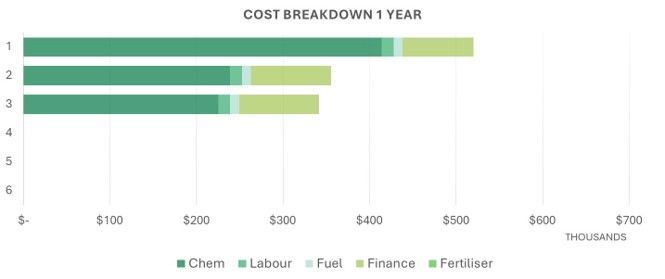
An example is shown of the output from the finance calculator in Figure 1. This example shows the cost breakdown for a conventional spray unit (1) as compared to a green on brown (2) and a combined green on brown and green on green spray unit (3). Here, the analysis demonstrates that green on brown systems, mounted onto a trailed sprayer can generate a sizeable reduction in chemical costs. In this farming system, green on green systems delivered fewer benefits, because most chemical applications were either applied to a summer fallow, or were pre-emergent. Each farm is unique, and individual results may not apply to your farm.