










































South Australia lifts GM crop ban

Paul Brescia

Farmers in mainland South Australia will be free to plant genetically modified (GM) food crops from the next season, with Kangaroo Island upholding its ban on GM crops.

The Minister for Primary Industries and Regional Development in South Australia, Tim Whetstone, noted that the Anderson Review, which looked at the ban’s effects on SA farmers, found that grain growers in the state were stung for $33m since the ban’s introduction in 2004, with a potential $5m extra in costs set to occur by 2025.

“The moratorium has cost South Australian grain growers, and harmed this state’s ability to attract investment in agricultural research and development. Considering the future economic impact on farmers, it is time to lift the moratorium on the mainland and provide farmers choice on crops they seek to grow.

“This reform will help increase farm profitability and drought resilience, create job opportunities in our regions, grow the state’s economy and attract greater research investment.”

A statutory six-week consultation is now open on the proposed amendment to the regulations to lift the moratorium on growing GM Food Crops in all parts of the state, except Kangaroo Island.

NEWS

December 18, 2025
Prodoz, a Proudly Australian and family-owned agribusiness, based in Melbourne, is strengthening its positions as national/international leader in advanced crop – science solutions through a growing portfolio of global innovation partners and a distribution footprint supported by all major distributors - includes Nutrien Ag, Elders, Lindsay Rural and Independent Rural stores.
December 18, 2025
Australia’s climate is tougher than ever. Heat spikes, dry periods, salinity, waterlogging and sudden frost events are becoming an everyday part of farmers lives.
December 17, 2025
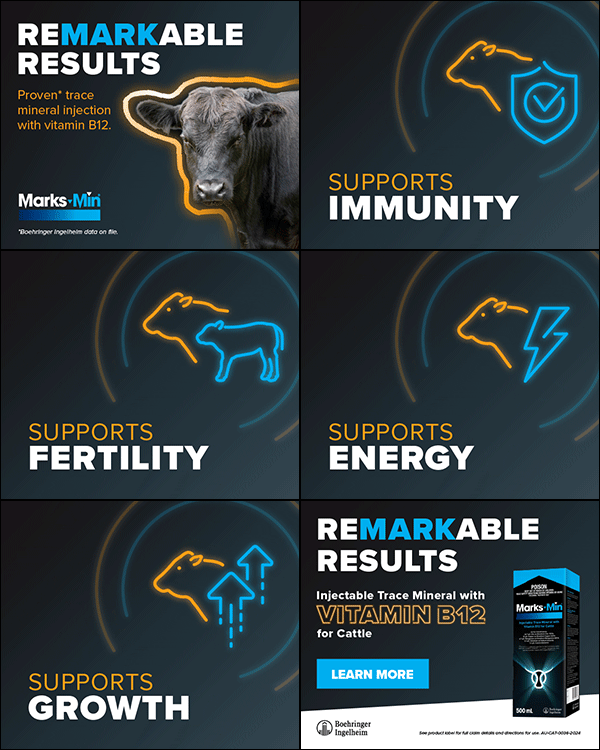
Trace minerals are required for optimal growth, reproduction, and immunity. Optimising trace mineral status relying solely on oral supplements across a herd may fail because of variation in individual intake and reduced absorption due to antagonism of other ration components and minerals. The use of injectable trace mineral supplements has been associated with positive reproductive outcomes including improved conception rate, increased odds of pregnancy and greater final in calf rate. A study conducted on 2,168 dairy cows, administered injectable trace minerals, four weeks prior to calving and again four weeks prior to the start of mating showed treated animals had a 3.3 per cent greater final in-calf rate, and a reduced time from start of mating to conception, compared to control animals 1 . The Importance of B12 Dr Carl Eden, Technical Services Veterinarian with Boehringer Ingelheim says “Vitamin B12 is sometimes referred to as a ‘super vitamin’ because it is only required in very small amounts but vital to many essential metabolic pathways. However, demand for B12 can vary considerably during the year and we see serum levels of B12 fall at critical times, such as the first few months after calving.” Vitamin B12 contains cobalt, so deficiency in cobalt can lead to deficiency in vitamin B12 because ruminants get most of their B12 as a byproduct of ruminal fermentation where the bacteria in their rumen assemble B12 from cobalt for use by the cow. Sub-optimal trace mineral and vitamin B12 status at calving, mating, and drying off has been shown to negatively impact growth, reproduction, and immunity. Using a trace mineral injectable containing vitamin B12 can improve trace mineral and vitamin B12 status at these critical times. Marks-Min with Vitamin B12 – The Evidence In the largest trace element study to date, Marks-Min Injectable Trace Mineral with Vitamin B12 demonstrated remarkable results when compared to a reference trace mineral injection. “Given the differences between Marks-Min and other products on the market, we wanted to generate a compelling data set to demonstrate how effective it was compared to the pioneer product. We entrusted this work to a third-party research company” says Dr Eden. “We chose farms that were at the top of their game from a reproductive perspective. We made sure that the farms had no evidence of trace element or vitamin B12 deficiencies or excess.” Across all outcomes of interest, Marks-Min demonstrated clear non-inferiority when compared to the reference product. Outcomes measured included submission, pregnancy and conception rates, and six week in-calf rate. Marks-Min demonstrated it is highly suited as an alternative treatment to the reference product. Reference: 1. Hawkins, D., and B. V. S. Franklin. New Zealand Dairy Veterinarians Newsletter 24 (2007): 12-16 Company website: livestockfirst.com.au Company email address: CustomerCare.Australia@boehringer-ingelheim.com Company video: https://vimeo.com/1138807630?fl=pl&fe=cm
December 17, 2025
Find out why the first summer drench can be so important in protecting your flock’s health, plus what to look for in your summer drench of choice.
December 17, 2025
A NSW-based innovator has developed a patent-pending, front-mounted firefighting and utility system for tractors, giving farmers instant, in-cab-controlled fire suppression, water and fuel on hand, and safer solo operations.
December 12, 2025
Barko Security is bringing drone technology to agriculture while building on a decade of security and a lifetime of agricultural know-how.
Show More