Shannon Beattie is Founder and Managing Director of Bush & Beyond Media. With a focus on agriculture and primary industries, Shannon shapes narratives that connect with farmers, industry and regional communities.
From precision to autonomy
Shannon Beattie
The Coggan family shares their experience about a practical path to smarter farming in Queensland’s Western Downs.

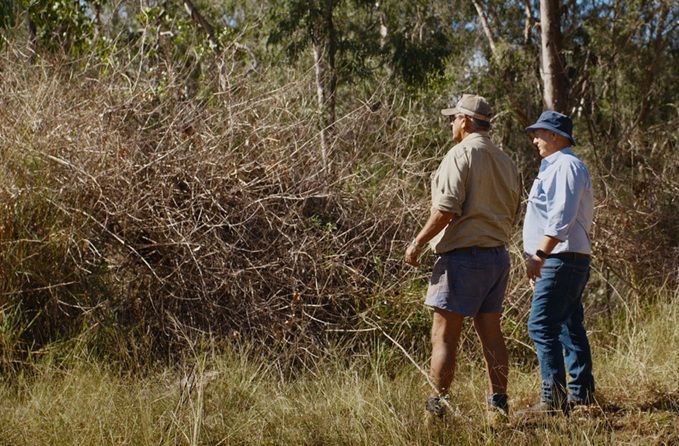
Tom Coggan (left) with Jocie Bate (centre) with Phillip Coggan (right)
When fifth-generation Queensland farmer Tom Coggan looked across the family’s vast cropping operation on the Western Downs, he saw a familiar challenge — not in the soil or the climate, but in people.
Keeping skilled operators behind the wheel of two spot sprayers for months on end through a hot Meandarra summer had become almost impossible.
“We were just struggling to keep labour units inside our spot sprayers or our camera sprayers,” Tom said. “We couldn’t keep the drivers in them for both machines running non-stop for four months straight over summer.”
That pressure point — balancing efficiency with workforce limits — became the catalyst for a broader rethink of how technology could work for the business. The result has been a gradual evolution from traditional precision agriculture into automation, a shift that now sees robotic sprayers running largely unsupervised across thousands of hectares.
The Coggans farm 23,000 hectares at Meandarra, cropping about 13,000 hectares each year and running a large livestock operation that includes 4500 cattle on feed and about 6000 lambs. It’s a business built on scale, but also on discipline.
“We’re a fifth-generation farming family and we’ve been on this site since 1937,” Tom said. “We crop about thirteen thousand hectares now with fifteen full-time staff, and that grows to around twenty-five during harvest.”
Running that much country efficiently has demanded constant refinement of systems and equipment. As the business grew, so did the need for more accuracy, more automation, and fewer wasted hours in the paddock.
Building a precision agriculture platform
The Coggans’ transition to automation didn’t happen overnight. It began decades ago with zero-till, controlled-traffic farming (CTF) and, in 2003, real-time kinematic (RTK) GPS guidance across the fleet.
At the time, the challenge was clear — inconsistent machine guidance was costing time, fuel and inputs. Each pass overlapped the last by as much as 30 centimetres — a small margin on paper, but a significant cost when multiplied across thousands of hectares.
“If you can bring that overlap back to three centimetres, it’s a massive saving year on year,” Tom said. “It’s saving on seed costs, chemical costs, labour costs, wear and tear — basically everything. The whole system’s efficiencies improved.”
The decision to invest in RTK wasn’t about chasing the latest gadgetry but about building on what already worked. “We try to pride ourselves on having equipment that does a successful job, whether that’s putting a seed in the right spot or spraying the right rate,” Tom said. “Using GPS at RTK subscription level was about maximising what we already do well.”
As data from RTK and yield mapping accumulated, the next challenge was input efficiency. Fertiliser was a major cost driver, and the team wanted to ensure they were applying it where it would deliver the best return. In another incremental step toward smarter resource use, variable rate technology (VRT) came into the picture.
“Part of the reason we went to variable rate was to increase the bottom line,” Tom said. “It wasn’t about saving money; it was about putting inputs where they’re going to return it.”
Adopting VRT came with its own learning curve, and the hardest part was wrapping their head around how to do it. “Once you’ve done it once, it’s easy, but getting that first map loaded and working properly was the biggest hurdle,” Tom said.
Because the farm already had sectional control on several machines, integration was seamless. Even without long-term yield data, the benefits have been clear. Crops in high-yield zones are healthier, nutrient distribution is more even, and fertiliser is being invested where it matters most.
“We haven’t necessarily seen higher yields yet, but the plant health in those high-yielding crops looks better,” Tom said. “It’s a system you have to stick at for a while to see the full results.”
Fighting resistance with camera sprayers
Chemical inefficiency and herbicide resistance were becoming growing concerns on the Coggan farm. Blanket spraying was costly and often ineffective, prompting the search for a smarter, more targeted approach to weed control. Herbicide resistance, particularly to glyphosate, had started to appear in some paddocks and was requiring a double-knock method to have any effective control.
The introduction of camera-guided optical sprayers provided a practical solution. Using sensors to detect weeds and apply chemical only where needed, the system reduced input costs and improved the effectiveness of each spray pass.
“The camera sprayers meant when we do that second knock, we can run a more targeted brew for that specific area, and we’re not putting herbicides on country that doesn’t need it,” Tom said.
In practice, the technology has cut chemical use by up to 85–90 per cent, aligning with industry figures, while delivering greater precision and consistency. Every litre of chemical is now applied where it will make a difference — reducing waste, curbing resistance pressure, and protecting margins.
Despite the success of the camera sprayers, one problem persisted — labour. The machines saved chemical but still required an operator for every hour of operation. “The value of those sprayers comes from keeping them going, and that’s one thing we couldn’t do,” Tom said.
Solving the labour bottleneck with automation
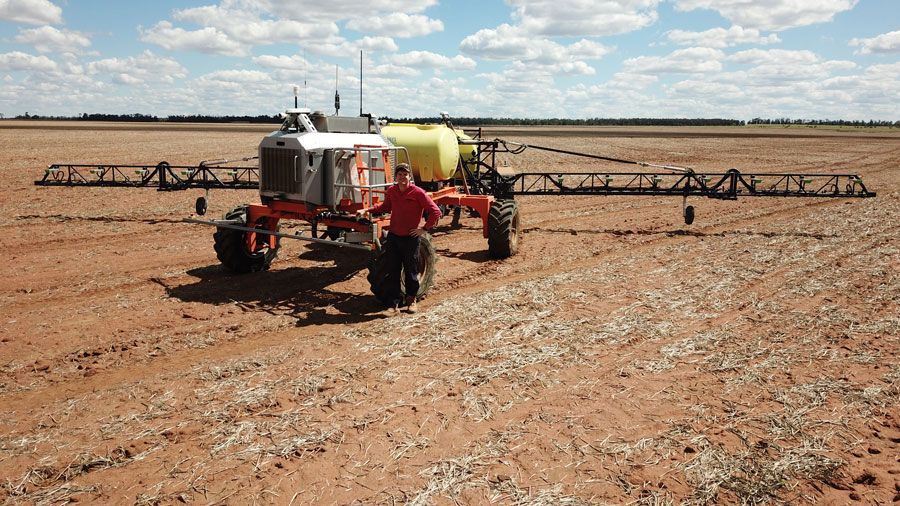
In 2021, two SwarmFarm robotic sprayers joined the fleet, carrying the same camera-sensing technology but running autonomously within the farm’s RTK network. “We already trusted the camera system,” Tom said. “Putting it on a robot just meant we could keep spraying even when no one wanted to sit in a cab all day.”
The shift has since delivered tangible results, with each robot now spraying independently for long stretches, freeing up staff for higher-value tasks such as maintenance, logistics and crop management. The robots don’t tire, don’t rush before rain, and deliver consistent coverage.
“The only thing they’ve really freed us up is labour units to drive other things or do other things,” Tom said. “I’ve got no data to back it up, but I honestly believe wherever our robots run, the country is cleaner.”
Although chemical savings remain similar to those of the camera sprayers, automation has turned a seasonal bottleneck into a predictable, efficient workflow. The Coggans’ next step is to automate refilling — one of the few manual choke points remaining. An autofill system is currently being commissioned to automatically top up the robots’ spray tanks between runs. The aim is to reduce downtime and make spray runs virtually continuous.
“It’s just about removing another stoppage point,” Tom said. “If the robots can refill themselves and keep going, it means less time waiting around and more consistent coverage across the program.”
Automation, in other words, isn’t about novelty; it’s about removing friction from proven systems.
Mindset and method
Across all technologies, the Coggans have learned adoption isn’t about speed, but strategy. The success of any system still depends on seasonal conditions, and no amount of technology can make it rain.
“The biggest problem we have in Australian agriculture is rainfall,” Tom said. “You can do all this special science and madness, but without rain you won’t see the results.”
For the Coggans, the solution is to make the most of every opportunity when conditions align. Precision systems help ensure every pass, every drop of rain, and every litre of chemical delivers maximum value. Whether it’s a three-centimetre overlap saved through RTK, fertiliser placed exactly where it’s needed, or autonomous sprayers running through the night, each decision is about extracting maximum efficiency from every operation.
Each decision is made carefully, but once adopted, the technology stays. “Farming’s been done the same way for generations,” Tom said. “Every new piece of tech forces you to look inward and outward — it’s always a bit scary. But if you don’t take the concept on and make it part of your system, it’s not going to be effective anyway.”
The return on investment might not always appear immediately, but the goal is clear — if it works effectively, it should be no more effort for more result. “We’re not here to make up the numbers just to have the tech; it’s got to pay its way to be here,” Tom said.
From RTK to robotics, every decision has been grounded in purpose — solving a real problem, improving consistency, and freeing people to focus on the work that matters most. “Some people think autonomy means losing that hands-on side of driving machinery,” Tom said. “But I see it differently — it just gives you more tools to do a better job of what you’re already doing.”
For the Coggans, automation isn’t the future arriving overnight. It’s the next step in a long tradition of progress — one that keeps them farming smarter, not harder.
NEWS
Invasive woody weeds steal your pasture. Method helps you take it back.
High-precision GNSS has typically been too costly and complex for all but the most critical agricultural operations, but recent RTK GNSS innovations have made centimetre accuracy scalable to all applications in Ag-Tech.
Every Aussie farmer knows that the difference between a “good” crop and a “record-breaking” one often come down to the smallest details. At BioFlora, we’ve spent years perfecting the balance of plant nutrition, and the result is IsoGreen – our powerhouse liquid formula designed to push your yields and crop taste to their absolute peak.
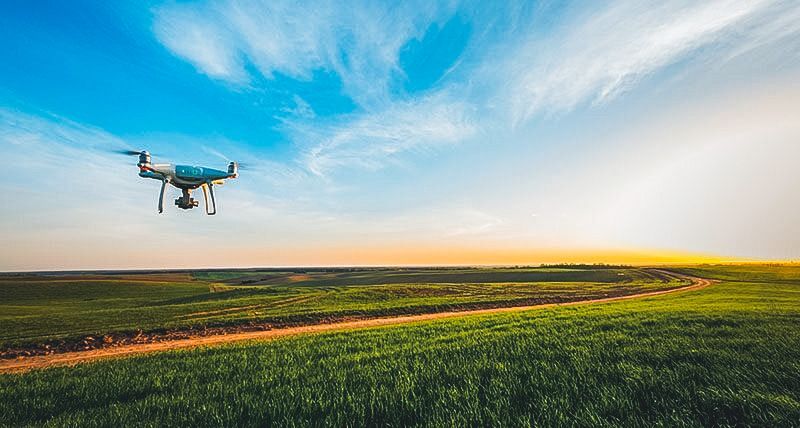
Plant, spray and harvest with confidence using reliable centimetre level positioning. Hexagon SmartNet provides fast, accurate RTK corrections across Australia to reduce overlaps, lower input costs and maximise productivity. With no base station required, simply connect, get a fix and get to work.

Built for the demand of Aussie farmers. Designed for every day performance.
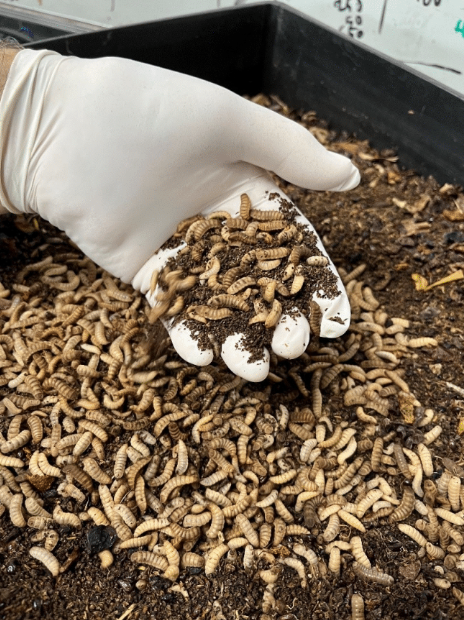
They’re wriggly black grubs more commonly tossed to backyard hens than served at the dinner table, but black soldier fly larvae could soon play a key role in building a more sustainable food system, according to new research from Adelaide University.