



























































1MG FlippingBooks
The role of the states in innovation
Boundless Plains to Share
Former Victorian Premier John Brumby takes a look at the role of the government - both federal and state - in fostering innovation.

There are a number of measures governments can and should take to support, grow and secure ongoing viability of regional communities. Basic services must be adequately funded and well maintained. Moving headquarters of government services to regional areas will stimulate local economies. Reliable and well-targeted infrastructure is also vital to regional communities and industries. But it’s also important to recognise that without a strong push toward innovation in regional and agricultural industries, none of these measures will be anything more than temporary.
Regional Australia is no stranger to the need for innovation. Agricultural life has never been easy. Early settlers were forced to innovate as they adapted agricultural techniques brought from the old country to a new land. Farmers still face traditional threats such as drought and disease, and as climate change continues these are likely to get worse, not better.
As Australia’s resources boom tapers off, many commentators, politicians and business leaders are aware of the need to tackle a lag in productivity growth masked to some extent by the growth in resources investment. Innovation is required right across the board, and agriculture and agribusiness are no exceptions.
There are new challenges to be faced, as well as new opportunities. The rise of Asia, for example, means the Australian agricultural sector must act quickly to seize the opportunities presented by a growing middle class. The World Bank predicts the global middle class will expand from 1.8 billion in 2009 to 5 billion in 2030. Rising wealth brings increased demand for protein-rich food, wine and other agricultural products.
The China-Australia Free Trade Agreement (ChAFTA) creates a wealth of new opportunities. Tariffs will be progressively eliminated on beef, many dairy products, wine and many horticultural products. Australia’s agricultural, forestry and fisheries exports to China are already worth $8 billion; we can expect this to grow considerably if Australian exporters are nimble enough to take advantage of a changing world.
But to meet the challenges and seize the opportunities of the 21st century, we must find new ways to increase crop yields, combat diseases, mitigate the effects of drought and develop new crop varieties to meet changing and growing demand. That means we need innovation. And improved quantity and quality is not enough; innovation is also needed to add value to agricultural products. Improved packaging, greater freshness and shelf life, lower environmental impact – today’s markets demand progress across the board.
There is a prevailing myth that innovation is the role of business, and the best thing governments can do is get out of the way. This is not right. There’s no question that the private sector can and should be a powerhouse of new ideas, experimentation and early adaptation of new technologies. But the fiscal, tax, regulatory and infrastructural environment in which innovation can occur is largely determined by governments.
The UK think tank Demos has pointed out that Silicon Valley, long seen as a triumph of the private sector, was the recipient of a great deal of government support in the early days (much of it through Stanford University), and that the algorithm that powers Google to this day was developed on a US National Science Foundation grant.
These are just two small examples of a larger truth: if government ‘got out of the way’ innovation would grind to a halt. While avoiding ‘picking winners’, governments can apply targeted interventions to encourage research and its application to old tasks and new challenges. Commercialisation is another area in which governments can play a role, and the current federal government is just now beginning to discuss what might be done to improve the commercialisation of Australia’s medical and other research.
In Australia, state governments also have an important role to play in encouraging innovation in general, and innovation in agriculture and agribusiness in particular.
Our government in Victoria took a particular, place-based approach to the regions, which involved looking at the needs and opportunities identified by local communities, and recognising that government has a role in stimulating growth. We restored services and invested heavily in infrastructure through the Regional Infrastructure Development Fund (RIDF), encouraged industrial giants such as IBM to move to regional centres like Ballarat, and led the way by decentralising government services such as Vicroads, State Trustees and the Transport Accident Commission (TAC). This ‘regionalist’ approach was subsequently adopted by the federal government.
But we also knew that a sustainable future for the regions meant bringing cutting edge research and technology to bear on traditional industries. Perhaps the best example of this is AgrioBio at Latrobe University. Our government entered into a $288 million public private partnership to build AgriBio, which is dedicated to finding new ways to increase productivity, fight disease and reduce the environmental impact of agricultural activity through biotechnology.
Biotechnology is the use of biological substances or processes for human purposes and scientists around the world are using it to tackle some of the biggest challenges we face, such as cancer and heart disease. The application of biotechnological breakthroughs to agriculture is no less important: the prediction that by 2050 the world’s population will reach 9 billion means food production will need to increase by 70 per cent. There is a finite amount of land – we have no choice but to make that land more productive.
Scientists associated with AgriBio have recently been involved in working out how certain environmental changes can interact with a plant’s genetic structure (known as ‘epigenetic change’) to help farmers maintain crop yields without the use of expensive fertiliser. This is important work, which could have important commercial implications down the line, but it cannot be done by the private sector alone. Government must invest in the facilities and scientific infrastructure to make it happen. Though the payoff may not be immediate, it will come in time.
US President Barack Obama put it well when he was pressured to cut science spending at the height of the Global Financial Crisis. This would, he said, be “like lightening an overloaded airplane by removing its engine. It may make you feel like you’re flying high at first, but it won’t take long before you feel the impact.”
To their credit, both Prime Minister Malcolm Turnbull and Leader of the Opposition Bill Shorten have acknowledged the value of becoming an innovative nation, and begun to lay out plans by which we can reach this goal. It’s therefore an exciting time in Australia. Both government and opposition are engaged in a conversation about the kind of nation we want to be post-mining boom. But we must remember state governments also have an important role to play, including in the areas of agriculture and agribusiness.
That means continuing investment in biotech and other agricultural research. It means fostering research partnerships in Asia, with whom we share so many challenges and opportunities, and where there are increasingly important markets. And it means creating strong communities in the regions, to attract and retain the people who will drive the future of our
regional industries.
NEWS

Invasive woody weeds steal your pasture. Method helps you take it back.

High-precision GNSS has typically been too costly and complex for all but the most critical agricultural operations, but recent RTK GNSS innovations have made centimetre accuracy scalable to all applications in Ag-Tech.

Every Aussie farmer knows that the difference between a “good” crop and a “record-breaking” one often come down to the smallest details. At BioFlora, we’ve spent years perfecting the balance of plant nutrition, and the result is IsoGreen – our powerhouse liquid formula designed to push your yields and crop taste to their absolute peak.

Plant, spray and harvest with confidence using reliable centimetre level positioning. Hexagon SmartNet provides fast, accurate RTK corrections across Australia to reduce overlaps, lower input costs and maximise productivity. With no base station required, simply connect, get a fix and get to work.

Built for the demand of Aussie farmers. Designed for every day performance.
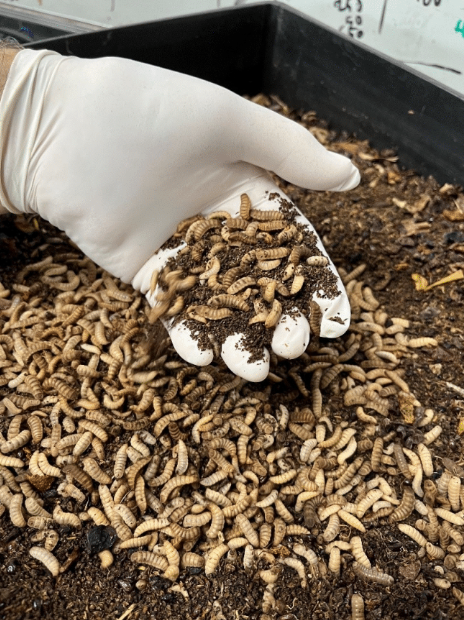
They’re wriggly black grubs more commonly tossed to backyard hens than served at the dinner table, but black soldier fly larvae could soon play a key role in building a more sustainable food system, according to new research from Adelaide University.